

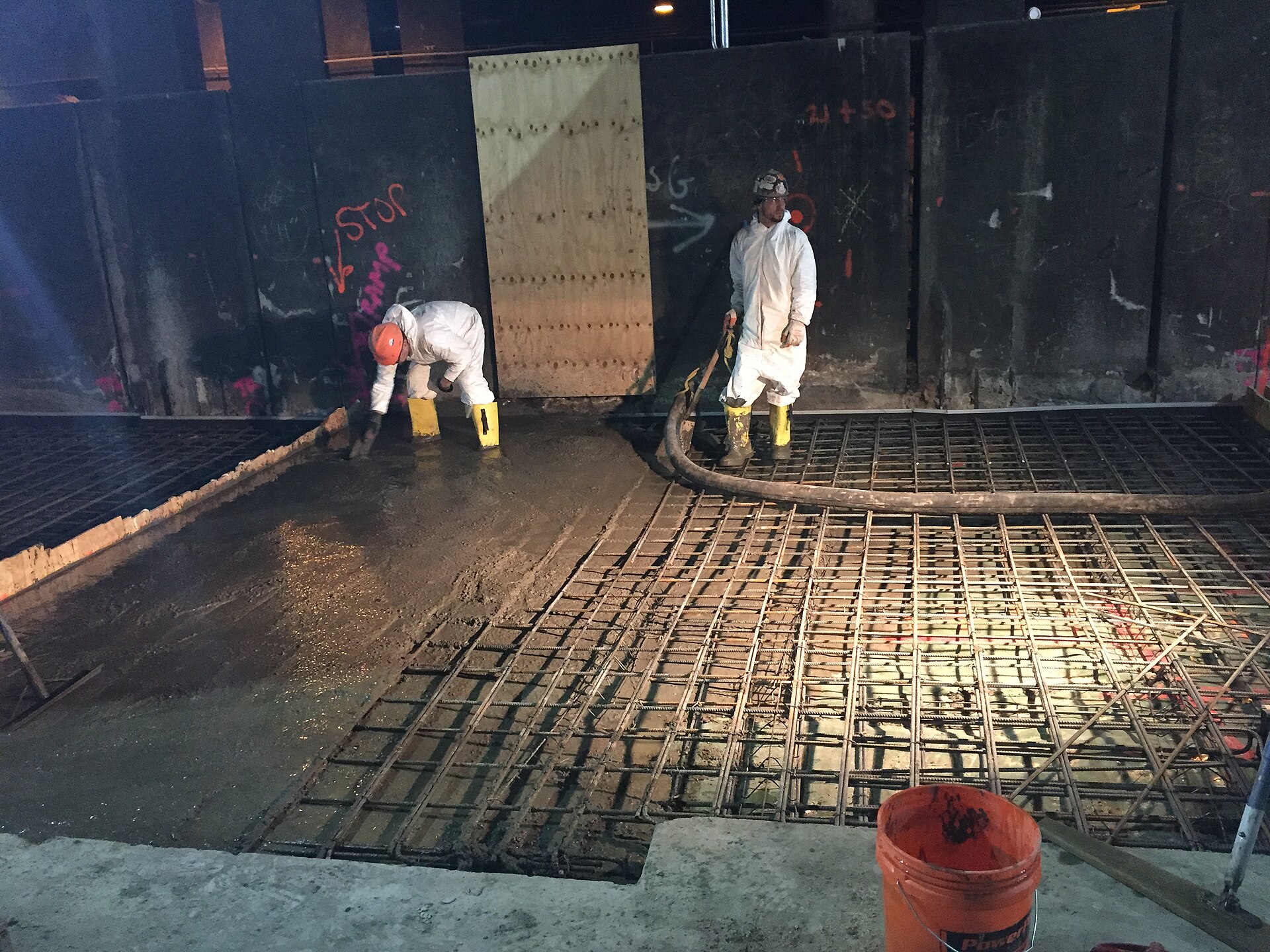

Commercial concrete testing is not just a stack of laboratory reports collected after a pour. It is a quality-control process that connects the specified mix, field conditions, placement practices, and acceptance decisions. For property owners, developers, property managers, and general contractors, a clear testing plan helps identify problems while there is still time to act—and creates a usable record for project closeout.
Whether the project involves a retail foundation, a multifamily building slab, or a heavy-use service area, the most useful question is not simply, “Did the concrete reach its strength?” It is, “Did the team verify the right requirements, at the right time, for the concrete actually placed?” This guide explains what to coordinate before delivery, what common tests mean, and how to handle results without relying on guesswork.
Start with the project specifications, not a generic testing checklist
There is no single testing package that fits every commercial concrete project. Structural foundations, interior slabs, exterior paving, and equipment pads can have different requirements. The design documents, applicable building code, exposure conditions, and owner criteria determine the acceptance process.
Before construction, have the design professional, general contractor, concrete contractor, supplier, and testing agency confirm the approved mix design and testing requirements. The plan should identify:
- Required compressive strength and the specified age for evaluating that strength.
- Any requirements for air content, concrete temperature, slump, or other fresh-concrete properties.
- Sampling frequency, sample location, and the number and purpose of test specimens.
- Who provides inspections, receives reports, and has authority to resolve nonconforming work.
- Requirements for reinforcement, slab thickness, elevations, surface finish, and curing documentation.
Industry references such as ACI 301 and ACI 318 may apply when adopted by the project documents or governing code. Their applicable editions and project-specific modifications matter; a general article cannot establish a project’s acceptance limits.
Separate contractor quality control from independent acceptance testing
The concrete contractor’s quality-control activities include checking site readiness, coordinating deliveries, maintaining placement practices, and protecting completed work. Independent acceptance testing provides another layer of documentation against the specified requirements. These responsibilities complement each other; neither replaces the other.
Ask who engages the testing agency and who schedules its technician. A missed notification can mean the first trucks arrive before anyone is available to collect samples. Also confirm whether special inspections are required and who performs them. A technician making cylinders is not automatically providing every inspection required for the project.
Complete the pre-pour inspection before trucks arrive
Concrete tests cannot compensate for buried construction errors. A successful commercial concrete inspection begins with the work that becomes difficult to see after placement. Use approved drawings and a documented hold point to review the following:
- Subgrade and base: Confirm required preparation, compaction verification, elevations, and correction of unstable areas.
- Forms and thickness: Check layout, top-of-slab elevations, intended slopes, and sufficient depth for the specified section.
- Reinforcement: Verify specified size, spacing, support, cover, laps, and any required dowel alignment or movement provisions.
- Embedded items: Coordinate anchors, sleeves, conduits, drains, and penetrations with other trades.
- Slab-specific details: Check vapor-retarder requirements, joint plans, isolation details, and transitions to existing construction where applicable.
Record discrepancies and resolve them before placement. For a broader look at the underlying assembly, see Caliber Concrete’s commercial concrete slabs and foundations overview.
Understand what fresh-concrete tests can—and cannot—tell you
Delivery tickets and mix identification
Review tickets to verify that the delivered mix matches the approved submittal and intended placement. Preserve batch information, delivery times, and documented site adjustments. If water or admixtures are added at the site, follow the approved procedures and limits, record the changes, and coordinate any required remixing and retesting. Do not add water simply to make finishing easier.
Slump and concrete temperature
A slump test provides information about the consistency of applicable fresh-concrete mixtures. It does not directly measure compressive strength or prove that the water-cementitious materials ratio is acceptable. Temperature testing helps the team evaluate compliance with specified placement requirements and weather-related procedures. Both results need to be interpreted against the approved mix and project specifications.
Air content and unit weight
Air-content testing may be required for the specified concrete, particularly where exposure and durability requirements make entrained air important. More air is not automatically better, and requirements for exterior concrete may differ from those for a hard-troweled interior slab. Unit weight, when required, provides additional information about the mixture. Let the specifications and qualified testing personnel determine the appropriate methods and limits.
Common ASTM references include C172 for sampling, C143 for slump, C1064 for temperature, and C231 or C173 for air content, as applicable. Listing a test method is not the same as setting a passing value.
Make strength specimens traceable to the actual placement
Compressive-strength testing usually involves specimens made from sampled concrete, handled and cured under prescribed conditions, and tested at specified ages. Standard-cured specimens are used to evaluate the concrete’s strength potential under standardized curing conditions. They do not directly measure the strength of every location in the finished slab.
Each set should be traceable to the placement date, sampling time, mix identification, truck or batch information, and location of placement. On a large pour, “main slab” may be too vague. A marked placement plan can make later questions much easier to resolve.
Provide suitable initial specimen storage and protect samples from disturbance and temperature extremes. Poor specimen handling can undermine the usefulness of the result. ASTM C31 addresses making and curing field specimens, while ASTM C39 covers compressive testing of cylindrical specimens; the testing agency should follow the applicable requirements.
Do not confuse early strength results with final acceptance
An early-age break can help the project team understand strength development, but it is not automatically the final acceptance test. Likewise, a specified-age laboratory result does not by itself authorize heavy construction traffic or equipment installation. Loading decisions depend on the actual construction condition, load demands, supporting conditions, and the design professional’s criteria.
Field-cured specimens or a properly established maturity method may support particular construction decisions when approved for the project. They serve different purposes from standard-cured acceptance specimens. Coordinate release criteria before the pour rather than improvising when a delivery or follow-on trade needs access. Caliber’s concrete curing and return-to-service planning guide explains why time alone is not a reliable release criterion.
Plan a response to out-of-range or low test results
For a fresh-concrete result outside the specified range, notify the designated decision-maker before placing affected material and follow the project’s retesting and disposition procedure. Document the load, result, adjustment, and final decision. Silence or a verbal assumption should not become the acceptance record.
A low strength result warrants review, but it does not automatically prove that the entire placement must be removed. The engineer may review sampling, specimen handling, test records, result patterns, and the affected location before determining whether further evaluation is necessary. Additional testing, potentially including cores, should follow an authorized investigation plan—not an improvised attempt to obtain a better number.
Keep the owner informed about the affected area, operational restrictions, next steps, and schedule implications. Avoid concealing questionable work beneath coatings or finishes before the team resolves the issue.
Build a commercial concrete closeout package that owners can use
A useful closeout package connects the paperwork to the property. Request approved mix submittals, delivery records, inspection reports, laboratory results, placement-location records, documented corrective actions, and applicable maintenance instructions. Confirm that unresolved observations have a recorded disposition.
Strength reports are only one part of acceptance. Depending on the scope, the project may also need verification of slab elevations, drainage, joint execution, surface tolerances, or flooring-related moisture conditions. A passing cylinder result does not establish compliance with all those requirements.
Questions to ask before scheduling your next concrete pour
- Which project documents establish the acceptance criteria?
- Who schedules testing and inspections, including the first placement of the day?
- Where will samples be collected, identified, and protected?
- Who can authorize adjustments or disposition of nonconforming material?
- What evidence is required before construction loads or property traffic resume?
- Who receives the final records, and how will they be tied to placement locations?
Caliber Concrete Company serves commercial clients across Florida, South Carolina, Georgia, North Carolina, Tennessee, and Alabama. If you are planning a slab, foundation, paving replacement, or other commercial concrete scope, contact Caliber Concrete Company to discuss site conditions, construction sequencing, and coordination needs. Bringing drawings, specifications, and the proposed testing plan to that conversation helps the project team identify responsibilities before work begins.